Everything You Always Wanted to Know About Art...
.... but were too 'pissed off' to ask?

Why does a banana taped to a wall sell for $120,000? Why do urinals end up in museums? Why should my tax money be wasted on art I do not appreciate or understand? What is the value of conceptual and abstract art—and what does it have to do with democracy?
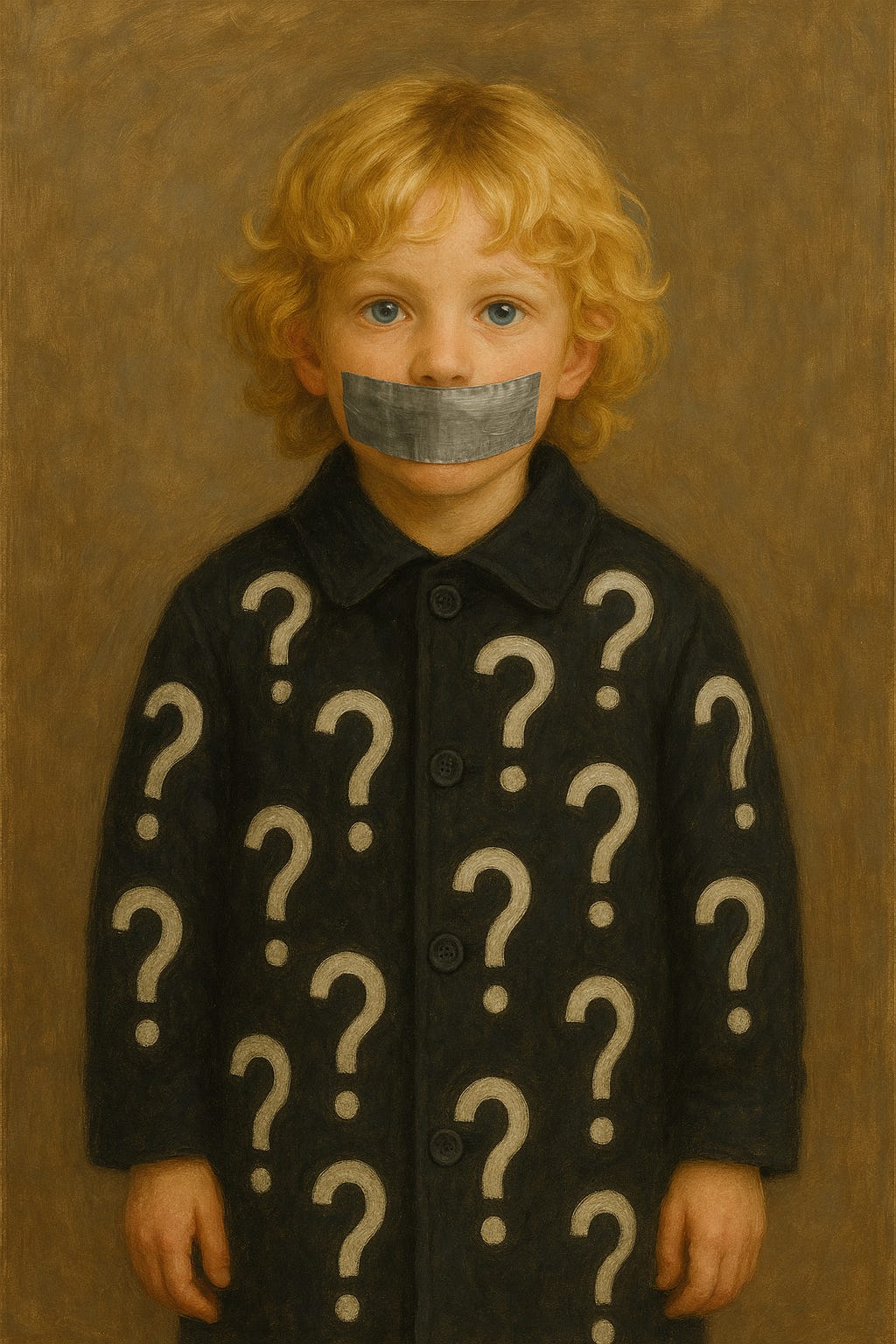
When I was nine years old, my teacher looked at me —and said: "I don’t understand you. I’d like to dress you in a black raincoat and paint question marks all over it."
I didn’t know whether to feel seen or sentenced. But I remembered it. I think she sensed something I couldn’t yet articulate: that I was living inside questions. That I was trying to find my place through seeing. And maybe that’s what art has always been for me—a raincoat of question marks, stitched with irony, curiosity, confusion, and grace.
It started earlier, of course. At six, I won a box of pastel crayons for a drawing of palm trees that ended up in the village’s cultural house. Someone had seen something in it—and in me. That mattered. It still does.
I grew up in a Protestant Dutch town where the church, the school, and the smell of sawdust shaped the days. My father built the school. My teacher smoked like a jazz singer. I drifted in thought, stared out windows, and eventually ended up in an art academy—and later, in an art psychology master's study—still asking questions: Why do we do this… make art?
Why does art matter, not just personally? But publicly. Socially. Politically.
In 1992, I wrote a thesis titled The Development of Taste: A Cognitive Approach to Aesthetic Judgment. Its premise was simple: taste isn’t innate. It develops.
Just like children learn to read, people learn to see the value of art.
The Hidden Curriculum of Art: Learning to See
We don’t always realize we’re developing. But we are. Taste evolves through stages, just like empathy, logic, or moral reasoning. The psychologist Michael Parsons mapped five stages of aesthetic judgment, to put it simple:
Favoritism – “I like it!” (Color, fun, good vibes)
Realism – “It looks real.” (Does it resemble the world?)
Expressionism – “It feels emotional.” (What is the artist feeling?)
Formalism – “It’s well made.” (Structure, balance, craft, tradition)
Open Formalism – “What does this mean here, now, to us?” (Critical, layered, reflective)
What struck me was how close these stages are to how we grow as people. At first, we judge the world by how it pleases us. We develop from a total egocentric being to a member of a complex society, where we begin to see through others' eyes, to consider intentions, systems, and contradictions.
Art becomes less just about beauty—and more about meaning.
And here’s the democratic kicker: when people develop aesthetic literacy, they also tend to develop social capacities. Empathy. Perspective-taking. Tolerance for ambiguity. That’s not just personal—it’s public.
When Art Confuses You, That’s the Point
Examples of three artworks help us see what’s at stake:
Duchamp’s Fountain (1917): A urinal turned on its back. At first, I laughed out of exhibitions. Later, hailed as a conceptual revolution. It wasn’t pretty. It wasn’t moral. It was a question mark. What is art? it asked. And who decides?
Cattelan’s Comedian (2019): A banana duct-taped to a gallery wall. Sold for $120,000. Then eaten. Viral outrage followed. But it wasn’t just a joke—it was a mirror. We weren’t laughing at the banana. We were watching the absurdity of markets, value, and spectacle unfold. The art was in the reaction.
Sun Yuan & Peng Yu’s Can’t Help Myself (2016): A robotic arm trying to clean up red liquid in a glass box. It moves with panic, exhaustion, and grace. Over and over. Until it breaks down. People cried in front of it. It wasn’t realistic—it was real. Emotional realism, not visual.
If you don’t get these works, don’t worry. You’re not alone. The key is: don’t stop there. Confusion is the beginning of insight.
Bible Belts: How Art Responds to Reaction
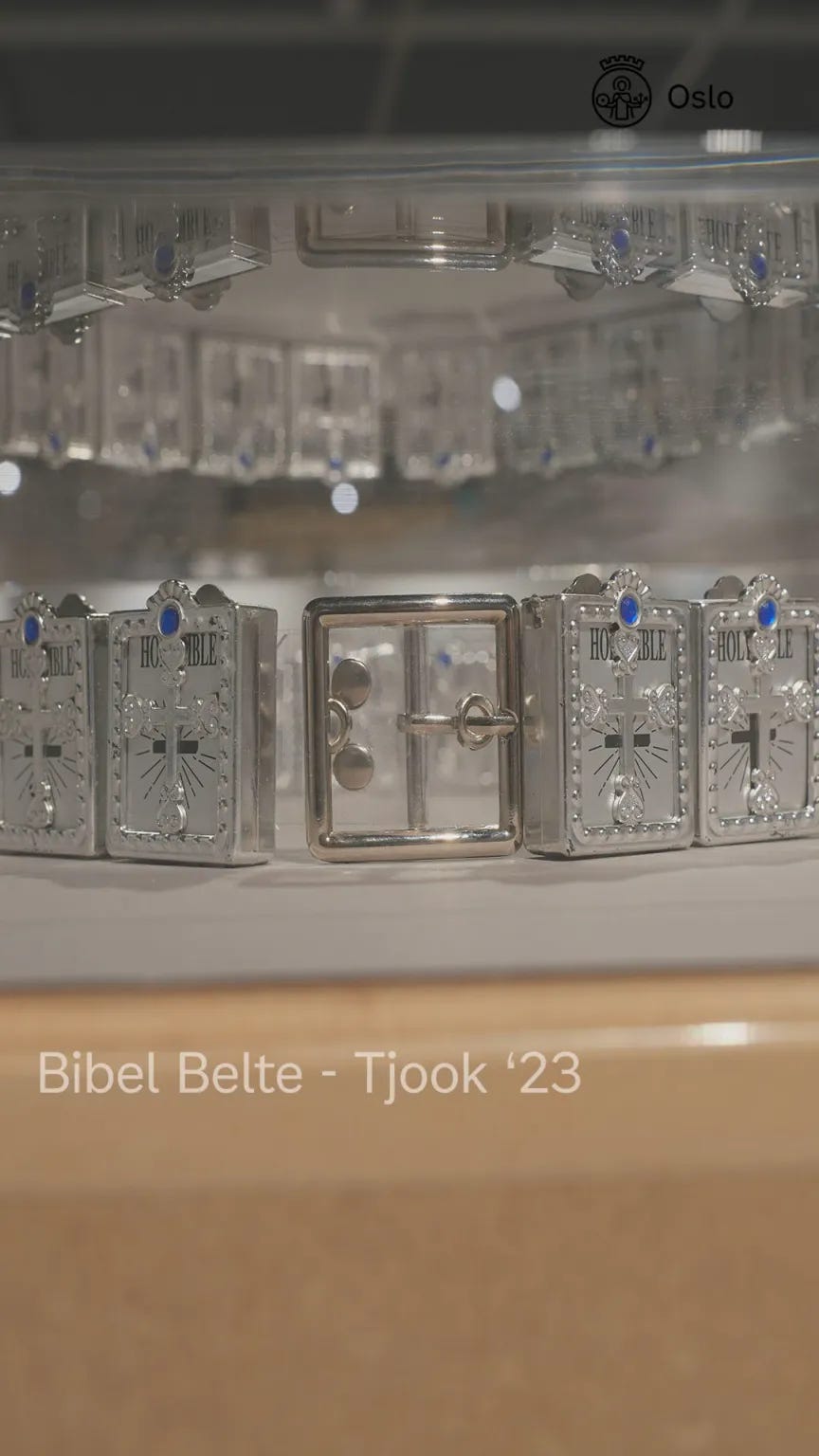
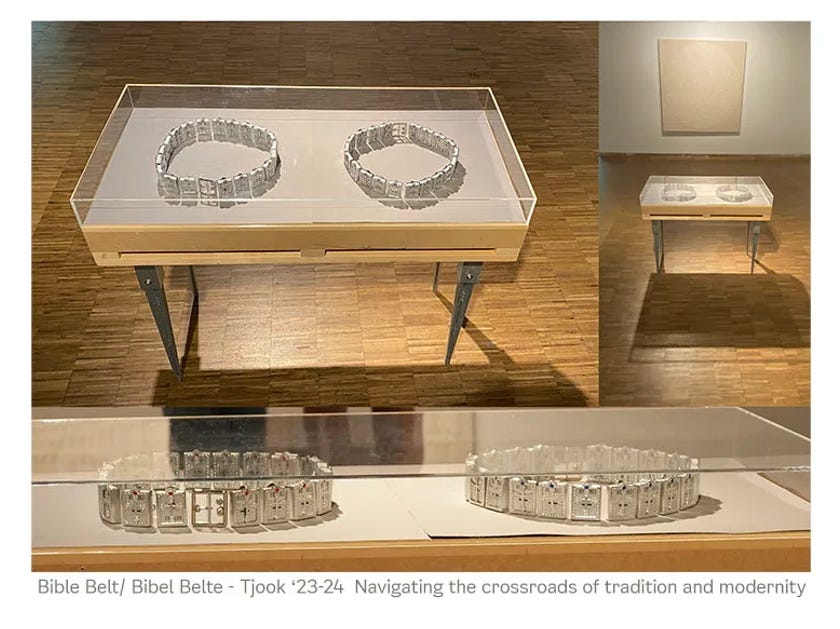
In 2023, I made a work called Bible Belt—a pair of transparent belts, studded with plastic rubies and miniature Bibles. Inspired by both the American South and Norway’s conservative heartlands, it was both homage and critique. Punk irony meets sacred longing.
Tradition can stabilize. But it can also be controlled. The belt restrains. But it also holds things up. In uncertain times, people reach for the familiar—often turning nostalgia into nationalism. My belts were a protest against that pull. But it was also a gesture of care. Because we don’t grow by burning bridges. We grow by standing in the tension.
As I wrote then: Backward into the Future doesn't mean nostalgia for its own sake. It means walking forward while clinging to old values, rules, and structures to feel secure. But that backward gaze can be dangerous. We risk tripping over the very questions we refuse to ask—when what we need is new thinking and fresh ideas, better adapted to today's human condition and reality.
And yes, taste is political: Why art needs public funding
Across Europe and the U.S., populist movements have mocked or defunded public art. In Norway, the anonymous Sløseriombudsmannen posted photos of funded performances with snide captions, inviting rage. In the U.S., “woke art” became a punchline. Budgets were cut. Grants revoked.
The argument is always the same: “Why should tax money fund something I don’t understand?”
But imagine saying that about books. Or science. Or schools.
We don’t defund reading because some can’t read. We teach it. We don’t cancel poetry because it’s hard. We invite people into it.
Art isn’t an elite scam. It’s a form of public education. It’s not decoration—it’s dialogue.
And the ability to enter that dialogue—to see, to reflect, to tolerate not-knowing—is essential to any healthy democracy.
The Raincoat Still Fits
Everything you always wanted to know about art begins not with knowledge, but with doubt.
Let the banana confuse you. Let the urinal provoke you. Let the robot break your heart. Let Bible Belts, as an artwork, make you wonder about reactionary ideas and values.
Because in the end, it’s not about the object. It’s about you who sees it. And if you’re willing to see—really see—then art is already doing its job.
Let it in. That’s how taste develops. That’s how democracy breathes.
Oh, and to answer the questions?
Why does a banana taped to a wall sell for $120,000? Because value in art is symbolic, not functional. The banana was a mirror of our absurd economy—art as commentary, not commodity.
Why do urinals end up in museums? Because context creates meaning. Duchamp’s urinal wasn’t plumbing—it was provocation. A question posed to us: What do you consider worthy of attention, and who defines what is worthy of your attention?
Why should my tax money be wasted on art I do not appreciate or understand? Public funding supports cultural literacy, empathy, and shared space for reflection. Democracy doesn’t require you to like every book in the library. But it needs the library. Art is no different.
—
🌀 Tjook
www.tjook.substack.com
www.tjook.com
#kunstogdemokrati #developmentoftaste #aestheticliteracy #tjook #artisdialogue #backwardintothefuture #duchamp #cattelan #sunyuan #pengyu #michaelparsons #piaget #kohlberg #selman